The Multitasking Myth: Why Switching Has a Cost
Task switching can make a busy hour feel productive while fragmenting demanding work. Learn how to group, alternate or separate tasks so each has a clear restart.

Task switching can make a busy hour feel productive while leaving demanding work fragmented. If you draft a report while answering chat messages, you are not giving both jobs full attention at once; you are repeatedly deciding which one deserves it next.
The practical issue is not whether switching is always bad. It is whether the way you arrange work makes it easier to keep track of priorities, respond when needed and finish what you started.
What multitasking means
People use “multitasking” for two different arrangements. One is pairing a familiar activity with something that needs little thought; the other is alternating between tasks that both require active decisions.
Walking along a familiar, unobstructed path while listening to a simple conversation may be manageable. A complicated crossing or an unfamiliar route changes the demands: you must attend closely to the immediate surroundings, and the conversation may lose your focus.
Writing a careful email and checking a spreadsheet are more likely to compete. Both involve holding details in mind and making choices. Moving rapidly between them may feel simultaneous, but each return still means working out where you left off.
Why switches disrupt work
A switch can break the sequence of a task. While editing a paragraph, you might be weighing a sentence, checking a fact and deciding what should come next. An incoming message makes you set that sequence aside, then recover it later.
That recovery might mean rereading a paragraph, retracing a calculation or checking whether an action is complete. The interruption does not necessarily erase the work, but it can make the next move less obvious and leave more room for an omission.
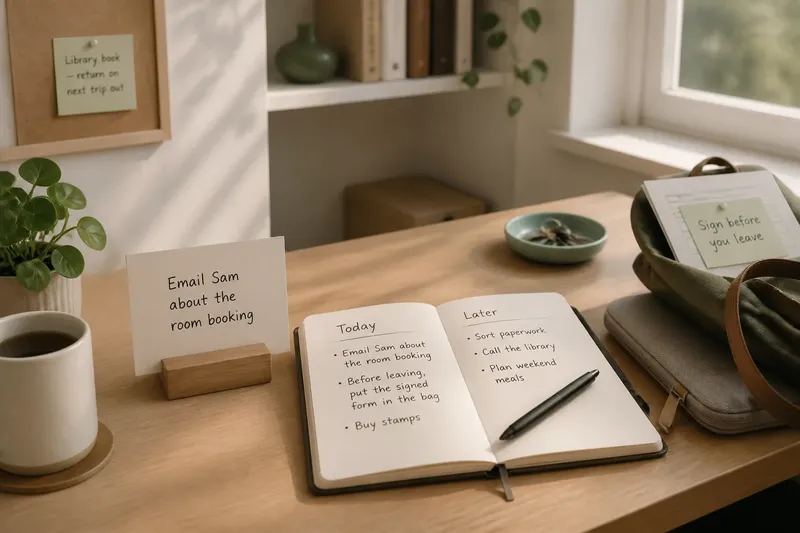
Say you are drafting a meeting note when a chat message asks whether the room is booked. You pause, check the booking and reply. Before turning to the message, you write “Room confirmed; next, add attendee names” at the end of your draft. When you return, that note tells you both what you completed and what to do next.
Three work patterns
Single-task blocks
Keep one demanding task in view, and silence or hide routine alerts if your responsibilities allow it. This can suit drafting, careful reading and editing, where a broken line of thought takes effort to recover. Keep a route for genuinely urgent contact if your role requires one.
Grouped messages
Choose a natural pause, then handle routine messages together rather than responding to each alert as it appears. For example, finish the paragraph you are writing before checking email and calendar changes. This preserves time to respond without letting every cue dictate the next task.
Planned alternation
Switch between tasks at deliberate stopping points. A report writer might draft a section, then check the notes supporting it before drafting the next. This works best when each activity has a clear place to pause; it is less suitable when either requires continuous attention or an urgent decision may arrive.
Choosing a work pattern
Base the choice on the task and its real demands. Ask whether two activities need the same kind of thinking, whether a response is genuinely time-sensitive and whether you can stop at a clear point. Then choose the arrangement that meets those needs with fewer unnecessary changes of focus.
- Check the task’s complexity: if it requires holding several instructions or a detailed argument in mind, protect a single-task block; otherwise, consider planned alternation.
- Check the message deadline: if a reply can wait until a natural pause, group messages; if it cannot, respond and record the next action before returning.
- Check for a stopping point: if the current task has a clear boundary, alternate there; if not, finish the smallest coherent part before switching.
- Check the activity paired with focused work: if it is familiar and needs little monitoring, pairing may be workable; if it needs close attention, separate the tasks.
- Check what you need to remember: if the next action or decision is easy to lose, write a restart note; if the task is already at a clear endpoint, resume from that point.
- Check the cost of a missed alert: if overlooking it could cause a serious problem, keep an appropriate alert channel active; if not, mute routine prompts during focused work.
Think of two books with bookmarks: if a bookmark slips out, you have to search for your place each time you return. A clear stopping point works like a reliable bookmark; it helps you resume without pretending the change of attention never happened.
Questions about task switching?
Can people do two things at once?
Some familiar activities can sit alongside a simple task that needs little active thought. When both tasks need careful attention, what feels simultaneous is often a rapid change of focus.
Why do I lose my place after an interruption?
You may have been keeping a next step or decision in mind while working. A message can displace that thread, so a brief note naming the next action can make resuming clearer.
Should I turn off every notification?
No. Some roles require a timely response, and some alerts matter more than routine messages. Keep the channel needed for urgent contact, and silence or group lower-priority prompts when your responsibilities permit.
How do I know which pattern suits me?
Notice what happens when you return to a task: do you continue from a clear point, or spend time rereading and reconstructing? If restarting is difficult, try grouping messages or writing a next-action note, then keep the approach that fits the work and its deadlines.
Make restarting easier
The multitasking myth treats quick movement between activities as proof that demanding work is happening all at once. A more useful question is whether you can identify the next action when you return.
For your next focused task, decide which interruptions need an immediate response, choose a natural point for checking routine messages and leave a short restart note before an unavoidable switch. That small record gives you a usable point of return without asking your memory to reconstruct the whole task.