Remember a View Before Taking a Snapshot
Remember a view by noticing its layout, choosing a few clear landmarks and sketching or describing them, so you can recall the scene later.
To remember a view, notice its layout before reaching for a camera. Choose a comfortable viewpoint, identify a few landmarks and describe or sketch their positions while the scene is fresh. A deliberate look gives details somewhere to belong, much as objects on a shelf are easier to recall when you remember where each sits.
You do not need to memorise every leaf or window. Start with relationships: a path leading towards a hill, a doorway below a sign, a boat beyond a pier. These anchors make a scene easier to reconstruct, while leaving room to mark anything uncertain.
Choose a clear frame
Pick a view with a manageable boundary: a garden from a bench, a street corner from the pavement or a room from its doorway. If the scene is busy, focus on a quieter part rather than trying to retain everything at once.
Stand or sit where you can look comfortably without blocking others or entering a restricted area. Decide what belongs in the frame, such as the stretch from a nearby gate to a roofline. Then make one unhurried pass across the whole scene and note its broad character: open or enclosed, still or moving, orderly or tangled.
Map the main shapes
Find the largest shapes and note how they relate. A low wall might be in the foreground, trees in the middle distance and a roof beyond them. Plain words such as “behind”, “beside” and “at the far edge” are enough.
Choose a few distinctive anchors: a fork in a path, a chimney, a gap between buildings or the curve of a shore. Trace a route through the view with your eyes, following a fence towards a gate or a stream towards a bridge. The route links separate details into a layout you can call back to mind.
Keep uncertainty visible. If a distant patch could be a doorway or a shadow, record that you are unsure rather than choosing the more plausible answer. A faithful memory can include gaps.
Choose distinctive details
Once the layout is clear, notice a handful of particulars that belong to this view: a colour against a contrasting surface, a crooked plant pot, worn steps or rain darkening one part of a wall. Attach each detail to an anchor or boundary instead of collecting it as an isolated item.
You can include sound, touch or smell where appropriate, but keep those impressions distinct from what you saw. A gate tapping may help place you in the scene; it does not identify what caused the sound. Note movement too, such as a branch leaning over a roof or a person crossing a square.
Describe the view
Make a short account aloud, silently or in a notebook. Begin with the broad setting, then name the anchors in order and add a few particulars. Spatial words preserve relationships that a list of objects would lose.
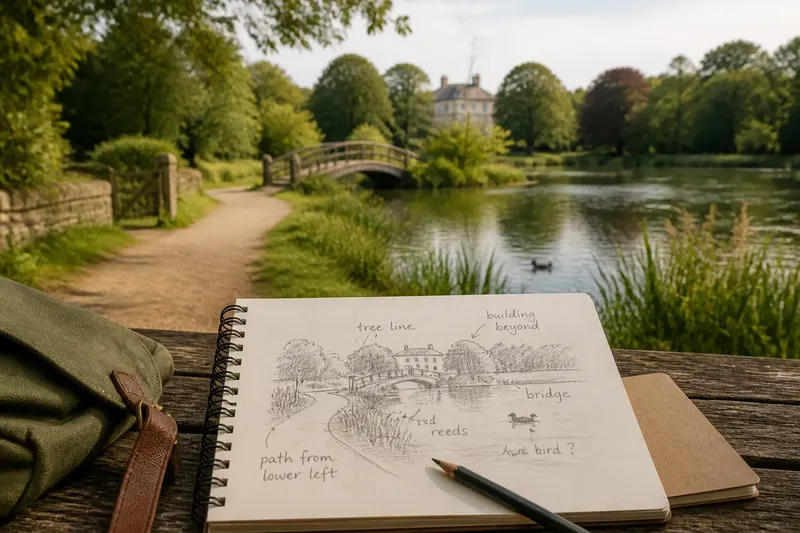
Say you are sitting on a park bench facing a pond. You notice a narrow path running from the lower left towards a small bridge, reeds along the near bank and a pale building beyond the trees. You describe those positions before leaving and add that a dark bird was near the far edge, while admitting you are unsure of its exact place. Later, the path, bridge and building give you a clear layout to recall; the bird remains a less certain detail.
Do not tidy the account into a more attractive scene. If the arrangement looks uneven, say so. If you cannot remember whether a blue door was on the left or right, mark the uncertainty instead of filling the gap with a guess.
Make a simple sketch
Use a notebook and pencil to draw a map, not a finished picture. Mark the frame, place the largest shapes and use lines for paths or boundaries. Add labels such as “low wall”, “gap” or “tree line” when words are clearer than drawing.
Keep the sketch spare. A line for the path and a block for the building can show their relationship without shading. Leave blank space for open ground or sky, and use a question mark or dotted outline for anything uncertain. If drawing is inconvenient, write a word-map instead: put a main anchor on the page and add notes such as “path left” and “roof beyond”.
Check your recall
After leaving the view, pause somewhere suitable and reconstruct it without looking back or reading your notes. Recall the frame and largest shapes first, then the route, particulars and movement. Only afterwards compare your account with any sketch or description you made.
Use differences to decide what to change next time. If you remembered a building but lost the gap beside it, link that detail to a route or boundary during your next observation. If your notes are hard to place later, add a caption such as “from the gate, looking towards the pond”, plus a brief note about conditions if they affected what you could see.
Questions about view memory?
How long should I look at a scene?
Look for as long as you can stay attentive and comfortable. Make one pass over the layout, then focus on a few details; stop when your attention starts to drift.
Should I write or draw first?
Choose the method that suits what you want to retain. A rough map makes positions clear, while a short description can capture sequence, texture and sound.
What if my memory is inaccurate?
Separate clear recollections from uncertain ones and avoid filling gaps with guesses. When you later compare your account with a sketch or the view itself, note which relationships need a stronger anchor next time.
Can I practise indoors?
Yes. Look at a room from its doorway, then turn away and describe the furniture’s positions or sketch the main boundaries. A familiar room can help you notice details you usually overlook.
Keep the method light
Use the same simple routine on a walk, at a station or in a public garden: choose a frame, name a few anchors, then make a compact description or sketch. Give other people room, and avoid drawing them in a way that intrudes on their privacy.
To remember a view, preserve its arrangement first and attach a few distinctive details to it. A short, honest account—including what remains uncertain—will give you a more useful prompt than a crowded page of guesses.