A Window Seat for a Rainy Afternoon
A rainy window observation exercise helps you notice raindrop paths, layered reflections and passing shapes without mistaking a quick impression for fact.
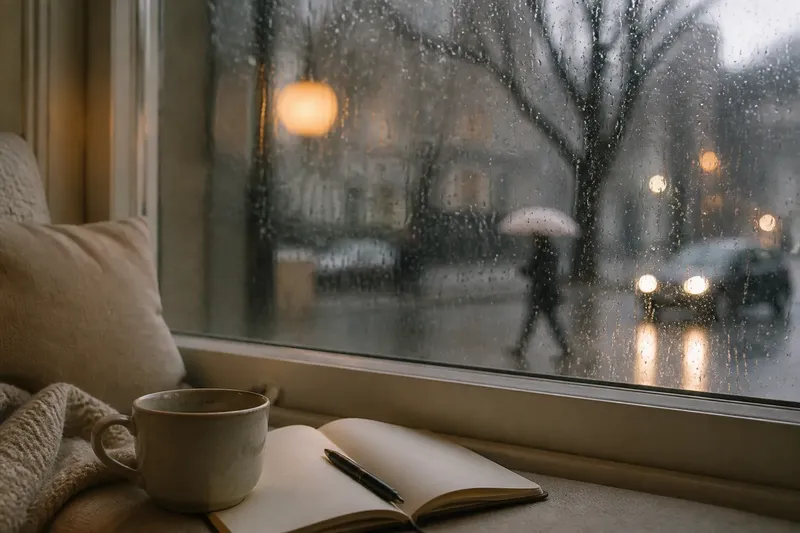
A rainy window observation exercise works best when you give one moving detail your full attention instead of trying to take in the whole street. Choose a comfortable indoor seat, settle on a raindrop or reflection, and watch how it changes. The aim is not to reconstruct the scene later, but to notice how shifting light and movement alter what is visible.
Choose a moving detail
Rain turns a window into a changing surface. Drops join, split or follow faint marks on the glass; reflections brighten and fade; shapes outside appear briefly between branches or passing vehicles. Pick just one of these events to follow. A narrow focus makes small changes easier to notice than scanning the entire view at once.
Use a notebook if recording a few words helps, but keep your eyes on the window more than the page. A phone camera can flatten the changing view into a single image, so leave it aside for this exercise. Sit where you can see comfortably, and do not lean out or open a window if the weather or setting makes that unsafe.
Follow rain on glass
Choose one drop and describe its visible features: its shape, position, edge and movement. Does it stay put, lengthen, tremble or meet another bead? If you lose track of it, restart with a drop you can see rather than filling in the missing part.
Watch for a change in its path. It may slide down, pause at a mark or merge with a smaller drop. Describe the sequence in plain terms—“it moved, stopped, then moved again”—instead of claiming to know its speed from a glance. The changing outline is the subject here, not a precise account of the weather.
You can also follow a small group of drops. Notice which touch, which remain apart and how the spaces between them shift. The window is like a marked-up sheet of tracing paper: each wet edge changes the view behind it, while the scene itself remains outside.
Separate reflections from scenery
A window can show an indoor lamp and an outdoor tree at once. Choose one layer, then shift your head slightly and watch what changes. A reflected light may move or alter in brightness as your viewpoint changes; an object outside keeps a different relation to the window frame. Treat those differences as clues rather than instant proof of what you are seeing.
Try describing the overlap before naming it: “a pale oval sits across the dark branches” keeps both visible elements in view. You can then consider whether the oval is a reflection, an object outside or a mix of the two. If the layers remain hard to separate, leave the description open.
Watch passing shapes
Wait for a person, bird, bicycle or vehicle to cross the view. Note its outline, direction and what hides it. Avoid identifying a specific person or object from a brief, rain-blurred glimpse. The useful detail may be its movement or shape, not its name.
Say you see a narrow dark shape move behind a tree, followed by a pale patch near the pavement. First note those two features without joining them into a story. When the shape clears the tree, you may see that someone is carrying a light-coloured umbrella; if the view stays obstructed, keep the identity uncertain. Either way, the initial details remain useful because they describe what was visible at each moment.
Rainy window observation exercise: what should you notice?
What if the view barely changes?
Attend to steady details such as the outline of a drop, the edge of a reflection or the boundary between wet and dry glass. If nothing moves, describe that stillness rather than inventing an event.
Should you write notes while watching?
Write only if it does not pull your attention away from the window. If taking notes interrupts the exercise, keep one short observation in mind and jot it down afterwards.
How do you handle an unclear shape?
Describe its outline, direction and relation to nearby objects, then leave its identity unresolved. An uncertain label is more accurate than a confident guess unsupported by the view.
When should you stop?
Stop when you feel strained, uncomfortable or ready to turn your attention elsewhere. You do not need to keep watching after the view stops holding your interest.
Compare what changed
Before moving away, return to one detail you followed and ask what changed: a drop’s path, a reflection’s brightness or a passing shape’s outline. If you made notes, compare the first description with the later view; if not, name the change to yourself. Keep the observation specific, such as “the bead joined a second drop”, rather than turning it into a broad judgement about the whole scene.
A rainy window observation exercise is useful precisely because rain keeps altering the view while offering no need for a definitive account. Leave the seat with one detail you can describe plainly. It gives you a sharper way to notice the next changing view, without asking you to make a story out of every shape.